Posts

New FOX TV Pilot “HR”…Will It Be A Hit?

I just finished reading a post discussing a new sit-com pilot on FOX with the working title HR. I’ll link to that article a little bit later, but for now let’s consider what this new show might mean to the world of Human Resources.

I certainly support the idea of a new comedy based around the Human Resources profession–no loss for material there. But I can’t help but wonder if HR will be short-changed. Now before you think that I’m just being a Debbie..er Donnie Downer, hear me out.

Workplace Comedy

People spend the majority of their waking moments at work. Sadly, for many it’s anything but funny. It’s dull, boring, and monotonous. Only 48% of U.S. workers are satisfied with their jobs according to The Conference Board–a nonprofit research organization that has conducted the Job Satisfaction Survey since 1987.

So why are workplace comedies so popular? I think Bob Newhart explained it well, “Laughter gives us distance. It allows us to step back from an event, deal with it, and then move on.”

When weary workers arrive home to ultimately plop in front of a screen, they’re looking for something. They want to escape. They want to get distance from their day. This can be done countless ways, but workplace comedy provides the opportunity to both escape and laugh at oneself. And for many, that is more than entertainment, it approaches a type of therapy.

So I know that I won’t find many sympathetic souls to join me in questioning the idea of HR as comedy. In fact, at first blush, the profession may seem to be tailor made for it. Even HR professionals themselves would likely agree that their jobs can frequently incite laughter, or at the very least amusement. People do funny things, and at work HR is there to…document it.

However, there is a risk that the Human Resources profession could–as often occurs–be unfairly painted with a broad brush. Frequently, HR is seen as the rule maker, rule enforcer, and both the source and destination for workplace grievances. Sure, a comedy could succeed in laying bare the hilarious truths and absurdities that HR silently, compliantly deals with–and that’s a great start–but what about the genuinely positive role of HR in the workplace? How is that story told?

The Other Side Of The Coin

Don’t get me wrong. I’m not trying to be a buzz kill here. A sit-com is not a social movement or cause. There is no requirement that it simultaneously function as a PSA either. Its goal is to maximize the number of people tuning in to laugh on a weekly basis.

But in looking back at some popular workplace comedies, yes, they were hilarious, but they also treated the professions they satirized with dignity. Think of TV series like M*A*S*H, Taxi, WKRP In Cincinnati, and Cheers. These shows produced a ton of laughs, but they also developed depth in characters, especially the lead roles. In this way, these comedies became something more for the viewers.

Of course, there are other workplace sitcoms with well developed characters, but these weren’t alone in portraying the dignity of a profession to the masses. These sit-coms were counterbalanced by a TV drama that focused on the same profession. For instance: Scrubs could be over-the-top zaney because ER was grounded; Night Court brought humor to the courtroom, while Matlock brought justice; and the motley team of detectives in Brooklyn Nine-Nine are a nice reprieve from Law & Order: XYZ.

Where Will “HR” Land?

As I said, a comedy around the HR profession should have no trouble providing hilarious stories. I will be watching the pilot episode, and I hope the show is funny and ultimately lands a series. But more importantly, I hope that this show succeeds in creating characters who portray the positive aspects of Human Resources professionals.

Yes, let’s laugh at the self-martyring employees, office pranks gone awry, and innocent, but thoughtless and inappropriate, workplace behavior. But let’s also see the real humans behind these HR roles, the ways in which they are trying to enhance the lives of employees, provide guidance on difficult personnel matters, and how they are trying to make the workplace less dull, boring, and monotonous.

If we can walk away from the pilot episode of HR with a dozen laughs and a greater appreciation for the work of Human Resources professionals, then I think FOX may have a very promising comedy in its hands. To learn more about HR, you can check out the SHRM post here. It gives you a detailed overview of the concept, the cast of characters, and a fun discussion about possible plots for this new show–it’s a fun read.


ExactHire provides hiring software for small- to medium-sized businesses that enables Human Resources professionals to spend more time with people and less time on process. 

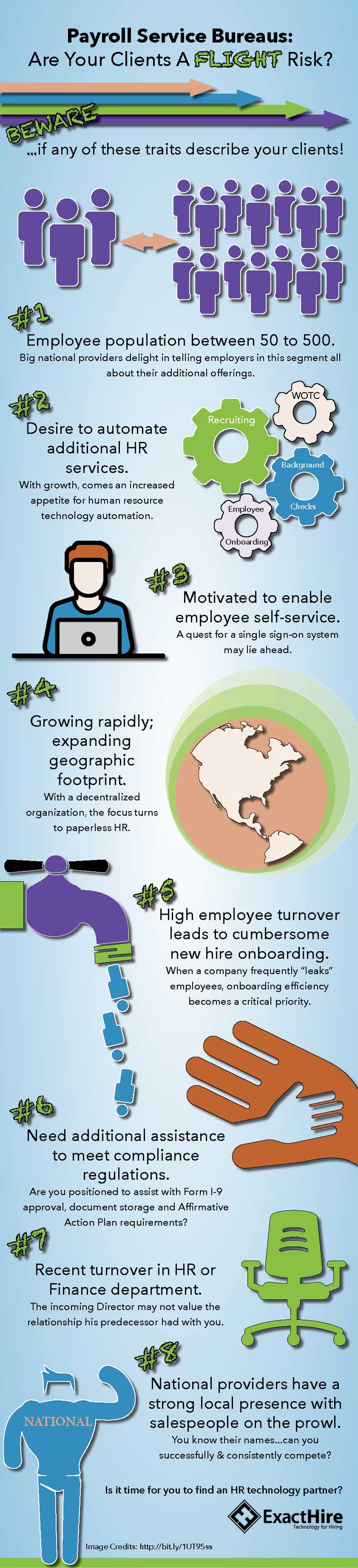
Payroll Service Bureaus – Are Clients a Flight Risk? [Infographic]

Payroll service outsourcing is nothing new regardless of whether you look at large employers, or organizations that fall within the small- to medium-sized business (SMB) space. However, advances in other human resources-related technologies in recent years have, for the first time, enabled increasing numbers of smaller businesses to automate administrative tasks related to recruiting, employee onboarding, the Work Opportunity Tax Credit (WOTC), background checking and reference checking. And, to do so for a reasonable price.

This presents a challenge to independent payroll providers because larger, national payroll organizations are packaging these additional HR services into a single solution and luring existing clients and prospects away from regionally-focused, independent payroll service bureaus. Want to identify the warning signs that suggest your clients may seek payroll services elsewhere? Check out the infographic below and learn how to spot the red flags that your customers may be a flight risk.

(Click here to enlarge)

payroll-providers-hr-services-infographic

Share this Image On Your Site


HR Software Provider Partnership Guide

What’s Your Recruiting Personality? [QUIZ]

Looking to get into the recruiting profession? Or, maybe you’re already a seasoned pro but just want to better identify your true recruiting strengths? Whatever the case, take ExactHire’s “What’s Your Recruiting Personality?” Quiz to identify your talent acquisition sweet spot.

From recruiting analytics and compliance reporting to social media and screening, this entertaining yet informative quiz will use your answers to ten short multiple choice questions to point you in the direction of your most prominent recruitment personality type.

Whether you’re happy managing metrics, driven by social shares or energized by candidate conversations…there’s a recruitment role that speaks to your passion. No matter which personality type you call your own, one thing is certain across all personalities…the recruitment field is always evolving and challenging professionals to adapt their sourcing styles.

This is especially true when it comes to navigating the mobile recruiting space. As a result, the ExactHire team has included examples of mobile recruiting software features especially well-suited for each recruiter type in each persona description.

What are you waiting for? Take the quiz and then share the results with your friends!

Mobile Social Recruitment Best Practices

Image Credit: Any Questions? by Matthias Ripp (contact)

Rewrite Your Talent Onboarding Story In 7 Game-Changing Steps

Once upon a time there was a talented, optimistic marketing professional named Simon. An exciting, fast-growth technology firm was fortunate enough to woo Simon during a flashy interviewing process and he was pleased to accept its offer of employment shortly thereafter. His new position would offer him more responsibility, more pay and a chance to learn some new technologies. Sounds like a storybook ending for Simon, right?

That’s what he thought, too, until he began to experience the firm’s employee onboarding process. While the tech firm had many things going for it, it had a few things to learn when it came to giving its new hires the best opportunity to be successful and productive in their working environment. Let’s see how Simon’s story unfolded and consider what the tech firm might have done differently to make a positive impression on him in the critical early days and months of his employment.

1 – Wait, What’s Pre-Boarding?

Once Simon accepted his offer, he still had to give his current employer a few weeks’ notice before finishing his job there. While his new employer was hiring frequently, and at such a pace that it often had employees start just days after accepting an offer, Simon was an anomaly in that he had some time to kill before his start date. Unfortunately, his new tech firm was radio silent during this period. Simon actually had to proactively reach out to confirm details like start date and arrival time. He wondered if his new company had forgotten about him.

Rewrite the Story: Simon’s new hiring manager could have called or emailed him to welcome him to the fold and prep him with some housekeeping details prior to his first day. This “pre-boarding” scenario (aka the period before official employee onboarding) is also a golden opportunity for an organization to send a welcome kit to a new hire with goodies like a prepared training schedule, visual organizational chart, fun facts about the company and some branded company swag.

A best practice during pre-boarding is to make sure that your company’s existing employees know about the forthcoming start date of your new employee so they can be ready to make him feel at home. This also gives the onboarding process stakeholders a chance to update recurring meeting requests and email distribution lists to include the new employee. Otherwise, Simon might feel silly if he was the only one that didn’t know to show up to the monthly corporate meeting.

2 – Learning the Unwritten Rules

Simon was an organized guy and liked to be prepared. During his interview, they told him that they had a relaxed dress code, but he still hadn’t seen any evidence of that and didn’t want to be the only guy in jeans on his first day. So, he showed up in business casual to be safe meanwhile contemplating the extent of the company’s flexibility when it came to the “flexible work schedule.” In addition, he was still in limbo with how daycare arrangements would work for his daughter, too. He would continue to feel a little stressed about that until he could adjust her drop-off and pick-up times to accommodate his new schedule. Of course his nerves weren’t helped when a bunch of his new co-workers asked him why he was so dressed up for his first day.

Rewrite the Story: Starting a new job is stressful enough; don’t make it worse by keeping your new hires guessing. At a minimum send new hires a Q&A sheet of commonly asked company culture-related questions before their first day.

  • Go the extra mile by pairing a new employee with a mentor buddy who can give him the real dish, and
  • assembling an attractive book or website full of pictures of your employees enjoying the unique aspects of your culture (for example, hitting the gong to celebrate a goal achievement or modeling work-appropriate attire).

Better yet, create a video office tour in which you interview employees that answer these burning company culture questions. Give employees like Simon the confidence to know when it’s actually okay to play ping-pong during work hours.

3 – You Mean I Don’t Even Get a Red Stapler?

Once Simon was shown to his working space, it was remarkably bare. While thankfully his laptop was awaiting him, there wasn’t much else other than tedious employment paperwork. His cube neighbor said that the supplies he needed were around, and that he could show him the office cabinet. So, Simon grabbed some sticky notes, a pen and a notepad since he wasn’t sure how much was appropriate to take. Back at his desk, he passed the time waiting for further direction (his boss was in a meeting on the morning of his first day) by investigating a new “twiddle your thumbs” finger workout on his smartphone…or at least he felt like that was what he was doing.

Rewrite the Story: Not having supplies ready on a new hire’s first day is frustrating and makes a poor first impression on a new employee. Stock a new hire’s space with all the essentials…have email setup, browsers downloaded and include a handy guide to applications that will be used on a regular basis. Complete the staging with a thoughtful welcome sign with the employee’s name. To make this setup easy on existing employees, too, have a basic onboarding checklist or template in place that can be quickly customized based on departmental needs. You don’t have to reinvent the wheel with every new hire.

Identify additional employee onboarding best practices like implementing software to automate both the workflow-related checklists for existing employees, as well as the actual paperwork completed by new employees. Instead of taking up two hours of a new hire’s first few days on the job with boring, redundant paperwork, give him a web-based portal to enter that data in about fifteen minutes. Make sure your onboarding process brand matches the sleek corporate brand that people have come to expect from a fast-growth tech firm.

4 – Be More Innovative Than Lunch

Simon was pleased to learn that he wouldn’t have to figure out lunch on his first day. His manager, as well as some other members of his department, did take him out to a nice restaurant to get to know him better. There’s nothing wrong with lunch as long as that’s not all you do to learn about new hires.

Rewrite the Story: Use your organization’s industry, resources and/or culture to create a unique experience for your new employees. For example, a technology firm might have a space for all employees to share their favorite mobile app along with comments about why each app was selected. A design firm with graphic artists on staff might choose to commemorate the arrival of newer employees by adding their caricature to a wall of fame after 90 days. An organization of travel buffs could have a giant world map and invite new employees to mark the exotic places to which they have traveled with pushpins. Be imaginative and discover each employee’s passion.

5 – My Brain is Only So Spongy

Once his first few days had passed, Simon had to admit that his training schedule did become quite rigorous…full of people to meet all day everyday. He was hustled from one office to another, desperately trying to absorb all the information he heard like the latest chamois cloth mop from QVC. Alas, cramming isn’t generally effective; however, sometimes employers still feel compelled to fill all the gaps in the first few week’s of an employee’s training schedule. While the firm did gain some points for doing its best to expose Simon to a number of areas in the hopes that he’d be more productive sooner, they should have allowed some time for his early foundational knowledge to soak in and then solidify.

Rewrite the Story: Consider a shortened training schedule for the early days of a new hire’s employment. By empowering an individual to train and shadow with others for just part of the day, you enable him to take the rest of the day to reflect and absorb the information gleaned. He can form questions, review the most recent lessons and be better prepared to be a true participant in the rest of his training activities. Incorporate gamification elements into the training and orientation phase by creating company- and/or department-specific quizzes to assess the employee’s learning while also providing entertaining education.

6 – That’s the End?

A month into his employment experience, Simon was starting to feel like a member of the team. Especially when he was thrown into the training mix for three newer hires that were starting the coming week. That’s right, Simon’s fifteen minutes of new hire fame were already up. And while it’s not a bad idea to help new hires hit the ground running by involving them in improving the onboarding process for future hires, you also don’t want to let your hair down too early with your newer employees. The firm was riding on its own cultural coat tails too aggressively. Keeping employees for the long-term requires a learning and development culture that doesn’t end after a new employee’s first three weeks on the job.

Rewrite the Story: Chart an onboarding course for the long haul and remember that the good stuff happens at milestones you intentionally plan for new hires along their entire employment journey…whether it is three weeks or one year into employment. Beyond new hire paperwork and software login credentials, build in triggers for activities like

  • more advanced learning “courses” once initial onboarding prerequisites are met,
  • exposure to other departments to better learn how one’s own job impacts others,
  • individual assessment in order to uncover opportunities for synergy between the newer employee, his hiring manager and/or other department members,
  • succession planning conversations, and
  • personal achievement recognition at notable anniversary dates.

7 – Get What You Expect

Being organized and self-motivated, Simon already had his own ideas about what he wanted to accomplish in his career with the tech firm. He certainly knew his own job responsibilities and had a vague idea of the potential career path available; however, he was foggy on his firm’s expectations when it came to targeting dates for specific skills mastery and project completions. He was looking forward to really producing now that he had a few months behind him, but he would have appreciated more detail about what success had meant for other top performers in the past.

Rewrite the Story: Having a culture of performance management doesn’t mean forcing a performance review every 90 days, or perhaps ever. But, it does mean having candid, personalized conversations with employees about their passions, developmental goals and the organization’s expectations for achievement. Create a job success factors document for all positions so that new and existing employees alike have a benchmark for comparing their own performance to the model for success for their role. Include details about initial job priorities, expected time frames for project completion and resources available from the organization to support the employee. Then, work with employees to align their strengths and passions with opportunities for increasing responsibility and rewards. Providing a map to success will set employees up to have a true sense of accomplishment once they’ve reached important job milestones.

Where Will Simon’s Story Take Him?

Is your organization guilty of any of the onboarding oversights that befell Simon in his new position? If so, take action now so that when your newer employees get a recruiter InMail message after seven months on the job they politely decline the chance to learn more about the next exciting, fast-growth tech firm.

This blog originally appeared on elementthree.com/blog.

Image credit: Swoosh Goes Swish by slgckgc (contact)

Mobile Recruiting Strategy Fails – When Your Organization Isn’t Prepared

You built a mobile recruiting presence, the applicants came…but then your organization wasn’t ready. Or, maybe you’re well on your way toward social recruiting Shangri La and you sense that a few hiring managers may be late to the party. In this blog, I’ll review five mobile recruiting strategy fails encountered when a business is not prepared in the hopes that you can avoid the same mistakes.

1 – Failure To Get Buy In

Even if you’ve already put a few mobile-friendly recruiting elements into play, or if you continue to evolve your social media content calendar to include career-related advice, you will still struggle if the rest of the team at your company isn’t prepared to buy into and participate in the new talent acquisition model. Start by educating them with statistics that paint a picture of this trend–no, this new way of doing business–to get their attention.

According to a 2015 survey by SHRM, 65% of employer respondents indicated they had sourced candidates from social media in the past year. And if it’s not your organization regularly leveraging the power of professional networking sites like LinkedIn or career community-focused networks like Beyond.com, then you can bet your competitors are.

Skilled workers who are willing and able to participate in the workforce aren’t as easy to come by these days. For example, in October 2015, recruiting difficulty reached a four year high for the 19th consecutive month according to SHRM’s Leading Indicators of National Employment (LINE) Report. Your organization must utilize the latest resources available in order to grab its share of scarce talent.

2 – Failure To Be Candidate-Centric

Remember when Tom Hanks’ character told Meg Ryan’s character that she needed to take it “to the mattresses” to save her business in the movie You’ve Got Mail? As you may recall, the dialogue was actually a reference to the famed Godfather; however, I like to mention the former, more recent movie because it represented how (at the time) email was a revolution in the dating game. It changed the face of courtship forever.

So now has social media and the proliferation of smartphones and tablets forced the evolution of talent acquisition. Take it to the mattresses. Be candidate-centric…maybe not in the same context that a staffing agency might because you have to fill a specific job rather than amass resumes for the future, but in a way that empowers your company to find the candidates where they are…on the networks and devices they are using. Don’t make it difficult for candidates to research your company online; and do make it easy for them to share jobs and positive career-related content on social networks when they want to chat with their peers about what they heard about working at your organization.

3 – Failure To Know Your Candidate Personas

If you fail to identify your target applicant audience across various job categories, then you will miss the mark when it comes to selecting specific social networks, mobile job posting apps and even customizing the applicant interface for your jobs portal to optimize your user experience (UX).

And while the thought that “mobile is coming” often conjures images of my favorite Stark family characters warning that “winter is coming” along with an onslaught of white-walkers in the binge watch-worthy Game of Thrones, the extent to which your organization needs to plan out its mobile and social strategy is dependent on the types of jobs you offer and the demographics and preferences of the top talent filling those positions. According to a 2015 Pew Research Center Report on U.S. smartphone use, it is lower income smartphone owners who are the most likely to use a phone during a job search.

Translation: The mobile candidate experience will make or break your recruiting success when it comes to your less specialized and entry-level positions.

Tweet This!


In fact, according to the report, “compared with smartphone owners from households earning $75,000 or more per year, those from households earning less than $30,000 annually are nearly twice as likely to use a smartphone to look for information about a job — and more than four times as likely to use their phone to actually submit a job application.” So ask yourself what percentage of your recruiting efforts focus on that population and then take appropriate action.

This insight doesn’t mean you can rest on your laurels if you manage HR at a professional office setting with higher income levels such as a physicians group or an engineering firm. Mobile is coming and the statistics on usage in the job seeker space will continue to climb across all income brackets.

4 – Failure to Communicate Internally

In your haste to reach out to candidates in their own space and ensure that your applicant tracking system is mobile responsive, did you miss explaining the consequences a more savvy candidate hiring experience will have on your internal stakeholders? If you’re not catching my drift, think about whether the following comments elicit a grin…or a chagrin.

  • Have you engaged hiring managers in the process of revamping your recruiting process? If not, then the shorter, concise job descriptions you may want to use may irritate them since they don’t understand why you are condensing details about their department’s opportunity. (The answer of course would be due to the shorter attention spans and impatient click behavior indicative especially of mobile job viewers).
  • Ever since social media has inserted itself into the selection process, the next generation of candidates who used to place phone calls to hiring managers and HR staff are now inviting employers to connect on social media; or, they are simply tweeting at your organization’s Twitter handle with specific job questions. With this increase in inbound activity comes the heightened responsibility for employer representatives to be ready to respond in the same manner solicited. And, for your organization to have documented policies on how you handle social media inquiries (using the best hashtags BTW) and candidate social screening.
  • Have you documented details on which social platforms and external job boards you use to post which types of positions? After all, what works for attracting manufacturing-minded machinists will probably fail miserably at securing interest from content marketers.
  • Have you discussed how to approach scenarios in which you may need to privately source talent for a position that is not yet open? If individuals in management but outside of recruiting are involved, a lack of coaching to show constraint when it comes to covertly posting future jobs can spell disaster for many…especially the existing employee who has not yet received the termination memo.

5 – Failure To Enable A Talent-Focused Culture

When was the last time you paid a placement fee to an external recruiter? Not something you want to do for every open position, huh? While there is certainly a time and a place for such engagements, in the meantime you should be focused on maximizing awareness for your job opportunities via in-house resources. The right approach starts with making sure that your existing employees, vendors, clients, alumni and friends know about the amazing roles available with your organization. The best approach kicks it up a notch (like Emeril) and incentivizes crowdsourcing behavior with a socially savvy employee referral program.

Make it easy for individuals to share your job listings with their networks using a unique permalink (URL address with an individual identifier) that tracks their referral activity and rewards them when their candidates are hired. Then, when it comes to amplifying the reach of your latest career-related content, share examples of suggested wording for social posts so that your co-workers can quickly copy and paste to spread your message (for ex., if they are outside of human resources and don’t necessarily want to spend time/thought on crafting their own version of a message). Also, consider whether any rigid social media policies or limited access to certain websites will limit your long-term hiring objectives by handcuffing your employees’ talent-focused social behavior.

This is the first post in a series of blogs about mobile recruiting fails. Stay tuned for the next post which will examine what happens when the technical aspects of your mobile-friendly recruiting experience don’t align with the rest of your hiring process.

ExactHire’s HireCentric applicant tracking system is a mobile responsive software application for your job posting and recruiting needs. Contact us for details today.

Image credit: FAIL Stamp by Hans Gerwitz (contact)

Trending: Reverse Job Fairs

Money makes the world go ‘round. And time is money.  So it is no wonder that companies and job seekers alike look for ways to save time and money in finding the right employer-employee match. A newer fad that seems to be catching on in the recruiting world is a trend referred to as Reverse Job Fairs, or RJF.

What Is A Reverse Job Fair?

Job seekers set up booths with science-fair like flair. Stacks of printed resumes, posters of accomplishments, degrees, pictures, recommendations, achievements, and samples of individual works can be displayed around the main attraction, the job seeker. All the while, hiring managers and recruiters can walk around and see what type of talent is available.

  • Employers Come to Candidates

    A divergence from the normal job fair, where HR professionals display information about their company and wait for candidates to act interested and approach their booth, this approach offers a different perspective. RJFs display the job-seeker’s assets and allow the HR/ recruiting role to peruse the stock of potential candidates.

  • Spotlight On The Candidate

    The time is now. As the job markets continue to become more competitive and companies are fighting over qualified candidates, this approach allows you (the job seeker) to present yourself in a way that highlights all your best assets and abilities.

  • Where Are RJFs?

    Many colleges are already setting these RJFs up for seniors and recent graduates to help them land the proper job that can launch their careers. Most colleges host industry-specific RJFs or organize them with a common theme in order attract many employers. Having a focused theme also yields a pool of qualified candidates with desirable traits.

  • How Much Does it Cost to Attend?

    Time is the biggest investment here. Not only in the time a job seeker stands at a booth, but in the time invested before the RJF. Like most things, you get back what you put into a RJF. Spending time to prep the booth, materials, and presentation are worthwhile for the job seeker.

  • Results

    Hiring managers and recruiters agree that RJFs offer them a good bang for the buck, so to speak. Being able to scan over 100 potential candidates in a few hours and dig in deeper to the most qualified candidates saves a lot of time.


ExactHire offers small- to medium-sized businesses the opportunity to save time and money with hiring technology. Applicant Tracking, Reference Checking, and Onboarding can all be automated and streamlined with the use of our cloud-based solutions. To learn more visit our exacthire.com or contact us today!

Image credit: DAY 255 (TEXT ADDED) by WEST MIDLANDS POLICE (contact)

How to Overcome Employment Screening Challenges in Small Business

I know from experience: being part of a small human resources department often creates a close-knit team, but the workload can make you long to clone yourself a few doppelgangers. Small business HR professionals are often slowed down with manual processes, like ordering background checks and chasing down references. Moreover, they are often pulled away to put out unexpected “fires”; thus, making it difficult to get to every to-do on time. That’s why more small- and medium-sized companies are looking for ways to accomplish more without adding expensive overhead in the form of extra HR staff members.

Our ExactHire e-book, The SMB Guide to Superhero Pre-Employment Screening, reviews best practices in pre-employment screening; including, application review, assessments, background checking and reference checking. In chapter six (embedded below) the challenges of traditional reference checking are reviewed. This chapter comments on how automated reference checking software can gather objective feedback more quickly and with little effort.

For the complete resource to help guide you in fighting potential inefficiencies within your organization, download ExactHire’s complete superhero-themed e-book. Think of automating the candidate screening process as a means to arm yourself with enhanced senses and special, super equipment. After all, what would Wonder Woman be without her lasso; or, Spiderman without his webbing?

SMB Pre-Employment Screening Guide Ebook
Image credit: Thunder of Hooves by JD Hancock (contact)

Fresh Eyes On Your Hiring Process

How is your hiring process? Does it get the job done? Could it be better?

Several months ago, new owners took possession of our office complex. Since then, parking lots were re-surfaced, carpeting was replaced, signage was updated, entry foyers were completely remodeled, and many other improvements were made.

Before the purchase, I think that most visitors walking into our building–myself included–would have considered it to be a pretty nice place. It got the job done. But the new owners, by seeing things through fresh eyes, were able to identify things that needed improvement. And now, it is indeed markedly better.

This leads me to the topic of improving your hiring process. Is yours, like most, similar to how our building was–functional, but in need of some improvements?

If you’re not sure, below are some items to contemplate when looking at your hiring process with fresh eyes:

5 Areas of Your Hiring Process To  Review

  • Career Page — Do you have one?  Does it really help potential applicants get a sense of why they might enjoy working with your organization?  Does it match the current branding of the organization?  Is it easily found through your website?
  • Application/Resume Submittal — Is it applicant-friendly?  Does it take too much time or effort for the applicants to get their information to you?  Can applicants apply from a tablet or mobile device?  Are you and your hiring team able to get the information you need to properly screen applicants for further consideration?
  • Consistency and Flow — Are all applicants for given positions considered equally?  Are the same screening/interview questions asked of everyone for given positions?  How is feedback from hiring managers and others gathered?  How well is the overall process documented?  Are applicants moved along smoothly and as quickly as possible?  Is there easy access to assessment results, background check results, reference check results, etc?
  • Communication — Do all the internal staff involved in the hiring process receive updates regarding the status of open positions? Are applicants notified as they’re moved through or out of the process? Are applicants notified that positions in which they’re interested are closing?
  • Future Needs — Are good applicants earmarked for future openings?  Do you have a mechanism to easily identify those good applicants when certain opportunities come available in the future?  Is there solid documentation to help remind you and others why these applicants should be considered for other openings?

Taking a fresh look at your hiring process may help you identify important areas for improvement. In making these improvements, you should see better efficiency and improved hiring results.


To learn more about how ExactHire can help you in your “remodeling” efforts, visit our website to learn about our HireCentric ATS and other HR Solutions or contact us today!

Image credit: Eyes For You by Alan L (contact)

Hiring Process Hurting Your Employer Brand?

Your marketing team has worked hard to ensure that marketing campaigns communicate exactly what your company promises to be–your company brand. So hard in fact, that people are listening and business is growing! Now your company needs to be on top of their game as they seek to attract and hire the right people–your employer brand.

When hiring–especially when hiring aggressively–the perception of your employer brand can start to go one of two ways: your employer brand is knocked as contrived marketing fluff; or embraced as an authentic representation of what your company is, who your people are, and how you seek to do business.

Frequently, the people applying for jobs at your organization are also the people most familiar with your company’s brand–and many times they are direct or indirect customers. They’ve received your marketing. Now, through the hiring process, they get to pull the curtain back and really see what’s going on. It’s important that you meet their expectations.

Delivering On Your Employer Brand Promise

Let us pretend that your company brand stands for integrity, prompt communication, truthfulness, and transparency. You’re on the hunt to hire people who exemplify those characteristics. As you begin the hiring process, you portray these characteristics yourself by outlining the stages of the hiring process and roughly how long each stage will take. Even if you were to reject an applicant at this stage, your employer brand has been upheld by communicating and being truthful. On target so far–your marketing department is loving this!

But the next thing you know, massive chaos has broken out across your organization. Maybe someone quit unexpectedly, or you’ve had a benefit provider change rates on you, or…chaos of whatever type. It’s all you can do to keep yourself from drowning, let alone notify individual applicants that the next stage in the hiring process has been delayed!

But you stay cool, and you find the few minutes it takes to update your applicants. Maybe it’s just a generic, automated email that’s sent out to all applicants remaining in the hiring process, but this simple effort supports your employer brand image. The applicants thank you, and the marketing team does too.

Breaking Your Brand Promise

But let us examine what might happen if you did not take those few minutes to send an update to the applicants.

Scenario 1: Your potential new hire may not trust you to be timely, transparent, or communicative– and that mistrust could remain once they’ve been hired as part of your organization.

Scenario 2: The applicant could assume that they weren’t selected, and that you–uncomfortable with confrontation–just didn’t want to break the news to them. This might lead them to take a position elsewhere.

Scenario 3 In the worst possible scenario, the applicant tells everyone they know about their negative experience thus far with your company, severely damaging your brand image. If you think this is hyperbole, think about a company that is hiring aggressively:

20 positions X 50 applicants = 1,000 brand promises broken

1,000 miffed people X 300 followers of miffed people = 300,000 people who now have a bad perception of not only your employer brand, but perhaps your overall company brand as well. Ouch.

What’s the Good Word?

Word-of-mouth is the oldest and still the hottest marketing tactic–good, bad, or otherwise. Your hiring process will likely touch a lot of people and generate conversations about your  company. These conversations can either tarnish or reinforce your brand. Ensure a positive experience for your applicants–don’t keep them in limbo. By staying true to your employer brand, you will strengthen your company brand.


Looking for hiring software tools to improve and maintain your organization’s employer brand? Visit our resources page for more information about our applicant tracking system and pre-employment screening software, or contact us today.

Image credit: NO se contrata a nadie by Bart Everson (contact)